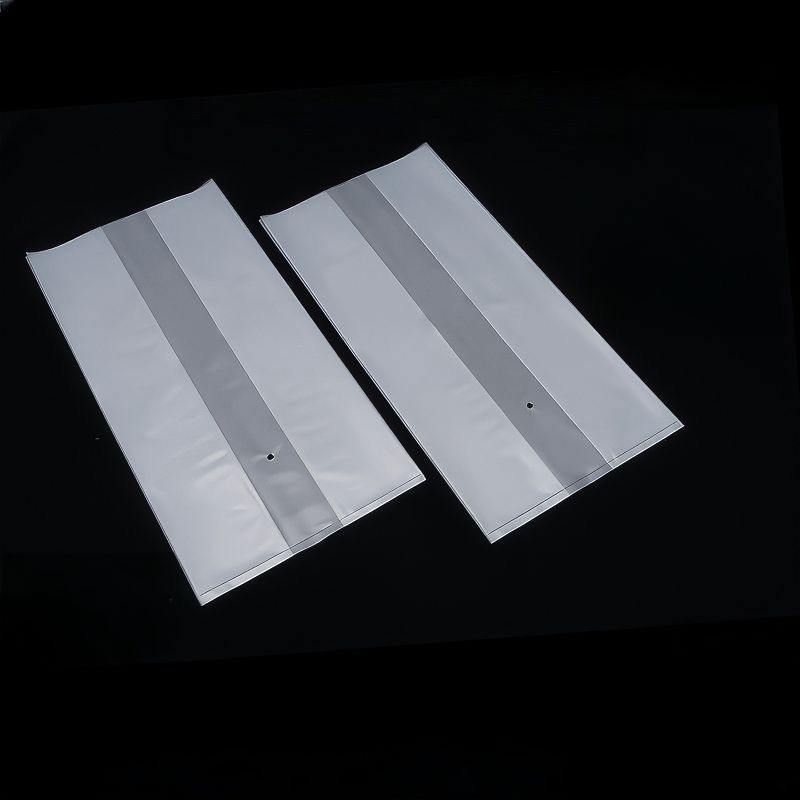
Flat Bag Width and Length
To measure a flat non-gusseted polyethylene bag accurately, smooth the empty bag onto a flat worktable with the open end facing the top. Recording dimensions in industry-standard sequence prevents transposed width and length tooling on the converting line.
- Width (W) is always stated first: Measure horizontally across the open mouth from left edge to right edge. On seamless tubular Bottom Seal Poly Bags, width runs crease to crease; on Side Weld Poly Bags, clarify whether width is outside-to-outside or usable inside width between the hot-knife side seams.
- Length (L) is stated second: Measure vertically from the open top lip to the inside edge of the bottom heat weld (excluding the short unsealed bottom skirt on bottom-seal bags) or to the bottom fold crease on side-weld bags.
- Sizing a flat bag around a 3D product: Because a flat bag has no side pleats, its front and back walls must wrap around product thickness (H). Start with Bag Width = Product Width + Product Thickness + 0.5 to 1.0 in. (13 to 25 mm) loading clearance, and Bag Length = Product Length + Product Thickness + 1.5 to 3.0 in. (38 to 75 mm) closure allowance for impulse sealing, taping, or tying—whether sizing shipping bags for folded shirts and hoodies or protective sleeves for boxed hardware.
- Always write the unit (in. or mm): One inch equals exactly 25.4 mm (2.54 cm). Writing bare numbers such as 10 × 14 without units risks confusion between inches (254 × 356 mm) and centimeters (100 × 140 mm). For continuous roll sleeves, see how lay-flat width relates to round diameter on Lay Flat Poly Tubing.
Measuring Gussets and Flaps
Expandable side pleats and extended top flaps add extra film geometry that must be separated from the main bag body on engineering drawings and purchase orders.
- Side Gusseted Bags (W × G × L): Measure flat Face Width (W) across the front panel, then pull one inward side pleat completely open to measure full Gusset Depth (G) from front crease to back crease, followed by usable Length (L) to the bottom seal. Never record the half-tucked flat fold (G ÷ 2) as the full gusset depth unless explicitly labeled—full open mouth perimeter equals 2W + 2G. Review Side Gusseted Poly Bags and our Gusseted Bags: Structure and Measurement for box-fit calculations.
- Lip and Tape Bags (W × L + Lip): On Lip and Tape Poly Bags, measure usable pocket Length (L) from the shorter front mouth edge down to the bottom crease or weld, then list the extended adhesive flap separately—for example, 12 × 15 in. + 1.5 in. lip (305 × 381 mm + 38 mm lip). Combining body and flap into a single total height leaves the packing pocket shorter than intended.
- Plain Extended Lips (No Adhesive): On open-top Poly with Lip bags designed for easy finger or air-jet opening on manual packing tables, specify body length plus lip height in the same separate format and state clearly that no release-liner tape is applied.
Usable Size Below a Zipper
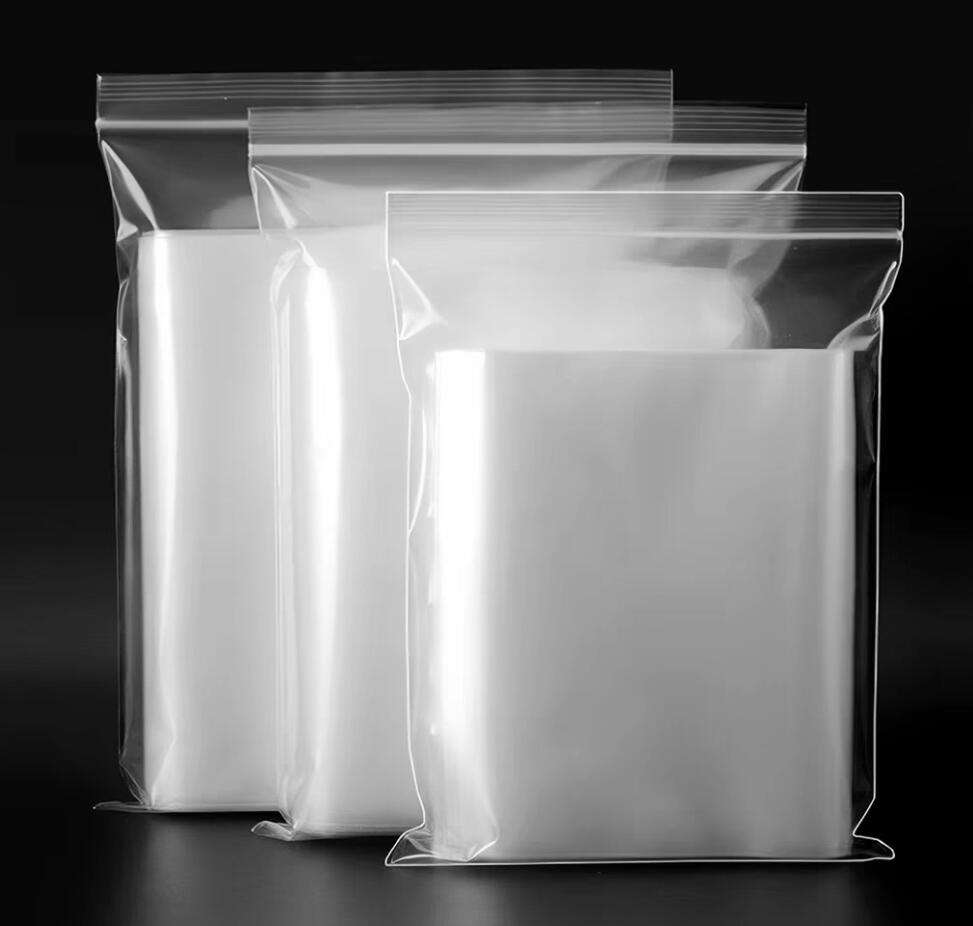
On Reclosable Poly Bags, overall exterior cut height is never equal to usable packing space. Industry convention defines reclosable bag dimensions strictly by the interior cavity below the press-to-close track.
- Measure length below the track: Lay the bag flat and measure vertically from the bottom edge of the interlocking zipper profile down to the inside bottom edge or seal—excluding both the rib-and-groove track and the top header grip lip (typically 0.5 to 0.75 in. / 13 to 19 mm above the zipper).
- Check interior width between side welds: Measure usable width from the inner edge of the left side weld to the inner edge of the right side weld so rigid cards, circuit boards, or kitted boxes slide past the stiffer track ends without binding.
- Add extra clearance for bulky contents: Because extruded zipper profiles are thicker and stiffer than bag film walls, three-dimensional parts pull the side seams inward near the mouth; test an extra 0.5 to 1.0 in. (13 to 25 mm) of width and usable length below the zipper before ordering large runs.
Dimensions Are Not the Same as Capacity
Buyers searching for a standard 1-quart, 1-liter, 5-gallon, 1-kg, or supermarket plastic bag size chart quickly discover that different catalogs publish very different inch and millimeter dimensions under the exact same label. In industrial polyethylene converting, capacity names, weight ratings, and trade nicknames do not enforce fixed geometric proportions.
Fluid volume (1 liquid gallon = 4 quarts ≈ 3.785 liters) can be achieved with a narrow, tall sleeve, a wide reclosable pouch, or a blocky gusseted liner—yet only one of those mouth widths will fit over your filling spout or shipping carton. Similarly, weight labels such as a 1-kg or 5-lb bag depend entirely on bulk density: 1 kg of steel hex nuts fills a compact heavy-gauge pouch, whereas 1 kg of molded plastic housings or apparel requires several times more internal volume. Always translate informal capacity or trade terms into flat linear dimensions around the actual item or container being packed.
| Informal Size or Capacity Label | Why No Single Fixed Dimension Exists | How to Specify Accurately for Quotes |
|---|---|---|
| Quart / Liter / Gallon Bags (e.g., 1 qt, 1 L, 5 gal) | Equal internal volume can be built with tall narrow flat panels, wide zipper openings, or deep side gussets. | Measure the target container, chute, or filled footprint and specify exact flat W × L (or W × G × L) in in. or mm. |
| Weight-Named Bags (e.g., 1 lb, 1 kg, 10 lb) | Occupied volume changes dramatically with part density, void space, and closure head space. | Pack a sample volume of your product, measure the required flat pocket, and state item weight separately to size film thickness. |
| Apparel & Shipping Names (shirt, hoodie, hat bags) | Folded garment dimensions vary by fold board size, fabric loft, and whether one or multiple units are bundled. | Measure the folded garment stack (Width × Length × Height) and add loading clearance plus lip-and-tape flap height. |
| Standard Retail, Travel, or Nursery Trade Sizes | Consumer carryout, travel-liquid, and agricultural nursery bags follow region- and vendor-specific conventions. | Send a physical measurement drawing or flat ruler photo of your reference bag rather than ordering by trade nickname alone. |
A Drawing Checklist for Your Quote
Use the notation format below when documenting Poly Bags for internal spec sheets or supplier RFQs so every converter quotes the exact same structure:
- Confirm measurement unit and tolerances: Mark every dimension explicitly in inches (in.), millimeters (mm), or centimeters (cm), and note any critical minimum or maximum fit tolerance (such as fitting inside a rigid carton or over a metal collar).
- Include single-wall film thickness: Pair linear dimensions with single-wall caliper in mil or microns (µm)—see our Poly Bag Thickness, Gauge and Weight Guide.
- Attach a flat ruler photo or dieline sketch: Email a PDF drawing or a photograph of an existing sample laid flat next to a ruler, using the contact options on our Request a Quote page, so seam style, skirt length, and closure placement can be verified before quotation.
| Bag Structure | Standard Dimension Notation | Example Spec Entry (Dual Units) |
|---|---|---|
| Flat Open-Top Bag (Bottom Seal or Side Weld) | Width (W) × Usable Length to Seal (L) × Single-Wall Thickness | 10 × 16 in. (254 × 406 mm), 2.0 mil (50.8 µm) single-wall, bottom seal |
| Side Gusseted Poly Bags | Face Width (W) × Expanded Gusset (G) × Length (L) × Single-Wall Thickness | 12 × 8 × 24 in. (305 × 203 × 610 mm), 3.0 mil (76.2 µm) single-wall |
| Lip and Tape Poly Bags | Width (W) × Body Length (L) + Lip Height × Single-Wall Thickness | 11 × 14 in. + 1.5 in. lip (279 × 356 mm + 38 mm lip), resealable/permanent tape note |
| Reclosable Poly Bags | Interior Width (W) × Usable Length Below Zipper (L) × Single-Wall Thickness | 6 × 9 in. (152 × 229 mm) usable below zipper track, single-wall mil specified |